Learning from Experience at Work Before Annual Reviews
Aldona Frelik – Workplace Coach · Systems Thinker · aldonafrelik.com
There are still some months to go before annual reviews and appraisal conversations begin. Promotion discussions and feedback at work often focus on results, goals, and performance.
But growth doesn’t happen once a year.
It happens in the hundreds of small moments between those conversations.
And interestingly, this time of year often brings something else with it. As summer approaches, many workplaces begin to slow down. Meetings feel a little less intense, inboxes a little quieter, and there is often more space to think between tasks.
That quieter rhythm matters.
Because reflection rarely happens in the middle of constant urgency. It tends to appear in the gaps, in the pauses between doing and reacting.
Perhaps that’s one of the gifts of summer. Not necessarily more time, but more mental space.
A chance to notice patterns in how we work, communicate, and respond. A chance to learn from experience before the next annual review, appraisal conversation, or promotion opportunity arrives.
For a long time, I didn’t know there were names for the process. I wasn’t following a model or using any particular framework. Through experimentation, curiosity, and gradually becoming more open to feedback, I noticed something interesting.
The more willing I was to observe what happened, reflect on it, and make small adjustments, the more I grew. Not only as an employee, but also as a person.
Years later, I discovered that much of what I had been doing intuitively had already been described by researchers and educators. There were names for these processes: feedback loops, Kolb’s Reflective Cycle, Gibbs’ Reflective Cycle, and Donald Schön’s ideas of reflection-in-action and reflection-on-action.
But perhaps the names matter less than the principle behind them.
We are always becoming.
Not fixed. Not finished. Not defined by a single success or a single mistake.
Just continually learning from experience.
Experience Is Not the Same as Learning
People often say that experience is the best teacher. Yet experience alone doesn’t guarantee learning.
Two people can go through the same project, presentation, annual review, or difficult conversation and come away with very different outcomes.
The difference lies in what happens afterwards.
Do we judge ourselves?
Do we dismiss feedback?
Or do we become curious?
Learning happens when experience is followed by observation, reflection, and adjustment.
Learning from Experience: Four Approaches
1. Feedback Loops
Work is full of feedback loops, even when nobody is formally giving feedback.
Perhaps you notice that a presentation landed differently than expected. A colleague responds positively to a change in your communication. A customer asks the same question repeatedly. A team meeting feels more productive when everyone has time to contribute.
These observations create opportunities for learning.
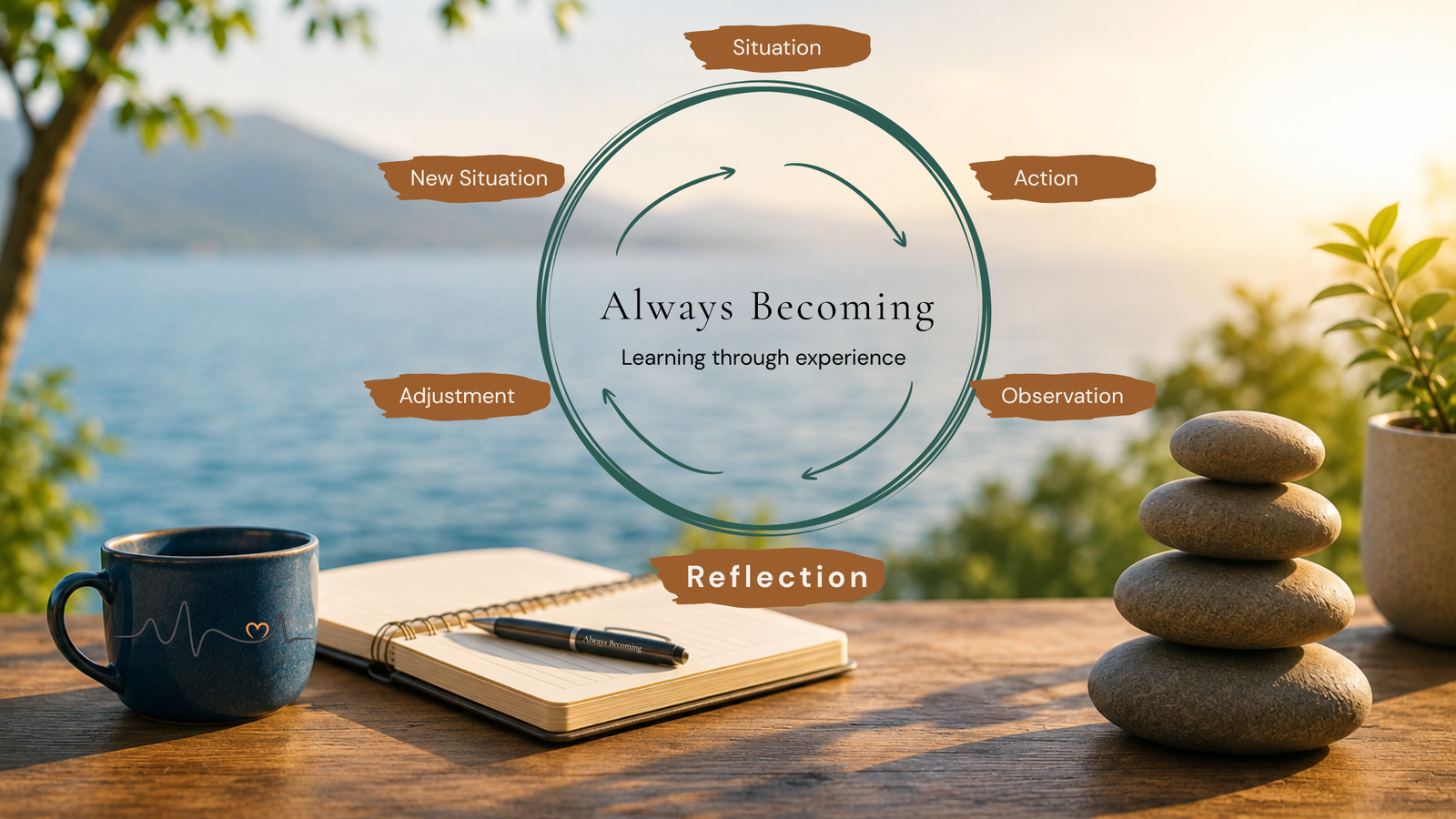
A Simple Feedback Loop:
Situation → Action → Observation → Reflection → Adjustment → New Situation
Feedback loops need time between inputs to become visible.
Sometimes the slower pace of summer gives us enough distance to recognise patterns that constant activity can hide.
Every new situation creates another opportunity for learning.
And we don’t only learn from our own experiences.
We also learn from: colleagues, customers, leaders, teams, mistakes, and successes.
The more aware we become of these interactions, the more intentional our growth can be.
Reinforcing and Balancing Feedback Loops
In “Thinking in Systems”, Donella H. Meadows writes:
“Systems with similar feedback structures produce similar dynamic behaviours.”
In other words, the patterns we repeatedly create tend to produce familiar outcomes.
Reinforcing Feedback Loops
Reinforcing loops amplify what is already happening.
For example:
Confidence → Speaking up more → Positive responses → More confidence
But reinforcing loops can also work against us:
Self-criticism → Avoidance → Less practice → Lower confidence → More self-criticism
Both patterns strengthen themselves over time.
Balancing Feedback Loops
Balancing loops help systems adapt and return to equilibrium.
For example:
Presentation doesn’t go as planned → Reflection → Adjustment → Improved presentation → Greater confidence
Or:
High workload → Fatigue → Rest and recovery → Restored energy
Constructive feedback at work often acts as a balancing loop. It provides information that allows us to adjust rather than simply continue in the same direction.
Understanding these patterns reminds us that growth is rarely linear.
Small adjustments, repeated over time, can gradually change the dynamics of the whole system.
And perhaps that includes the systems within us.
2. Kolb’s Reflective Cycle
Educational psychologist David Kolb described learning as a continuous cycle.
-> Concrete Experience
-> Something happens.
-> Reflective Observation..
-> You step back and notice what happened.
-> Abstract Conceptualisation
-> You identify patterns and lessons.
-> Active Experimentation
-> You try something differently next time.
-> And then the cycle starts again.
Kolb’s model reminds us that experience alone isn’t enough. Reflection and experimentation turn experience into learning.
3. Gibbs’ Reflective Cycle
Graham Gibbs developed a six-step framework for deeper reflection.
Description – What happened?
Feelings – What was I thinking and feeling?
Evaluation – What went well and what didn’t?
Analysis – Why did it happen?
Conclusion – What have I learned?
Action Plan – What will I do differently next time?
This approach can be particularly useful after presentations, difficult conversations, projects, annual reviews, or appraisal discussions.
Instead of asking:
“Did I do well?” we can ask: “What can I learn from this?”
4. Reflection-in-Action and Reflection-on-Action
Donald Schön described two kinds of reflection.
Reflection-in-Action
Thinking while doing.
Perhaps you notice that people look confused during a presentation, so you slow down and explain differently.
Reflection is happening in real time.
Reflection-on-Action
Thinking afterwards.
What happened? What surprised me? What worked? What would I change next time?
Both forms help us develop professionally and personally.
Feedback Is About Performance, Not Identity
It took me many years to learn that constructive feedback – good or bad – is not a verdict on my character. It is just the information on the performance. Nothing less and nothing more. And the performance can always be adjusted, if I make such decision.
Constructive feedback at work is about performance, behaviours, communication, and approaches. Not about who you are as a person.
And performance can change. Skills can improve. Communication can be refined.
Habits can evolve. Experience can be built.
That’s why reflective practices are so valuable. They help us move from self-judgement to curiosity.
Instead of asking:
“What’s wrong with me?” we can ask: What happened? What influenced the outcome? What worked well? What could I try differently next time? What am I learning from this experience?
Constructive feedback gives us information, not labels. It allows us to draw conclusions, make adjustments, and continue growing.
The goal isn’t perfection. The goal is learning.
Because careers are built not by getting everything right the first time, but by repeatedly noticing, adjusting, and developing over time.
Growth Happens Between Annual Reviews
Annual reviews, appraisals, and promotion conversations matter.
But growth happens long before those meetings. It happens when we become more aware of the processes happening around us, and within us.
When we stay curious. When we allow feedback to inform rather than define us.
When we see every conversation, challenge, and experience as information rather than evidence of our worth.
Perhaps that’s what Always Becoming means.
Not becoming perfect. Not finally arriving. But continuing to learn from experience, with a little more awareness, a little more wisdom, and a willingness to adjust along the way.
Because maybe we don’t just have experiences. We participate in feedback structures.
And by changing those structures, we can change the patterns they produce.
Continue the Conversation
Growth rarely happens in isolation. Some of the most valuable lessons come from observing ourselves, listening to feedback, and learning from the experiences of others.
That shift from judgement to curiosity, needs practice. And practice needs a container. For me, one of those containers has been Toastmasters International, where constructive feedback is woven into every meeting.
At this point, I would like to leave a few questions to reflect on:
What experience taught you something important at work?
Have you ever discovered that a challenge or mistake became a turning point for growth?
Which of these approaches resonates most with you: feedback loops, Kolb’s cycle, Gibbs’ reflection, or simply learning through experimentation?
I’d love to hear your thoughts and experiences in the comments.
Perhaps growth isn’t about having all the answers. Perhaps it’s about remaining curious enough to keep learning.