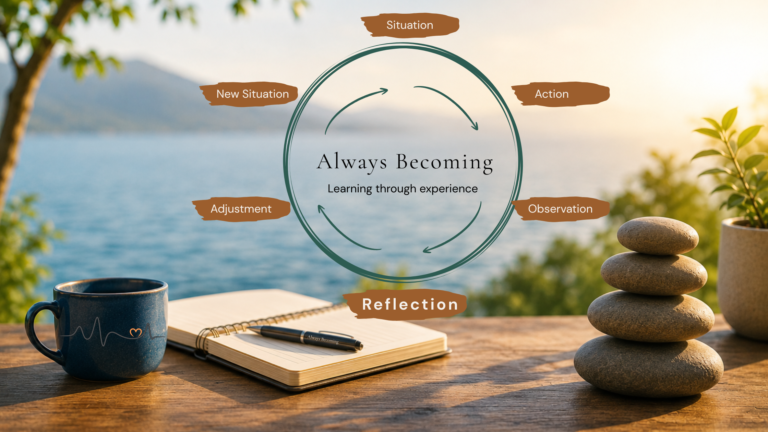

What Is Coaching? Coaching vs. Therapy, Mentoring, and Other Helping Professions Explained
Aldona Frelik – Workplace Coach · Systems Thinker · aldonafrelik.com
1. Why there’s so much confusion
What is coaching, exactly? Most people couldn’t tell you, and the confusion costs them. Therapist. Psychologist. Mentor. Psychiatrist. Counsellor.
We use these words as if they’re interchangeable. They’re not. Each represents a different profession, with different training, different tools, and a different goal.
This matters more than it sounds. The right support at the wrong time can leave you feeling stuck, or worse, can keep you away from the help you actually need. Knowing what each profession does, and doesn’t do, is the first step to seeking the right kind of support at the right time.
This post is a reference. Not a sales pitch for coaching. Just the basics: what coaching actually is, how a coaching session differs from time with a mentor or a therapist, and where each profession’s job starts and ends. I’ve made my best effort to lay it out clearly enough that you can make your own decision.
2. What is coaching?
Let’s start with what it isn’t. Coaching is not advice-giving.
A coach, sometimes called a life coach, though the title covers far more than that one word suggests, doesn’t position themselves as the expert on your life. You are.
So, what is coaching, then?
It’s a structured conversation, as the International Coaching Federation defines it, built to help you:
– gain clarity
– think more deeply
– challenge your own assumptions
– make decisions
– identify goals
– take responsibility for action
A coach doesn’t fix you. There’s nothing to fix. There’s something to think through, more clearly than you’ve been able to alone.
Coaching works with:
✓ goals
✓ decision-making
✓ confidence
✓ communication
✓ leadership
✓ transitions and career change
✓ habits and accountability
✓ values and priorities
✓ work-life balance
✓ stress management (non-clinical)
Coaching does not treat:
✗ trauma
✗ depression
✗ anxiety disorders
✗ personality disorders
✗ PTSD
✗ addictions
✗ eating disorders
✗ severe mental health conditions
Those belong to qualified mental health practitioners. A good coach knows the edge of their own competence and won’t pretend otherwise.
3. Tools used in coaching
Coaching isn’t about handing over answers. It’s about facilitating reflection and creating the conditions for you to see something you couldn’t see on your own. Broadening or changing the perspective.
Questions – used to explore perspectives and assumptions you haven’t examined yet.
Listening – beyond the words, to the patterns and beliefs underneath them.
Goal setting – SMART goals, outcomes, action planning. Turning a vague direction into something concrete.
Values exploration – clarifying what actually matters to you, as distinct from what you think should matter.
Accountability – the structure that turns insight into consistent action. Insight alone rarely changes anything. Action does.
Reframing – looking at the same situation from a different angle.
Strengths-based work – building from what’s already working, rather than starting from what’s broken.
Reflective exercises – journaling, the wheel of life, visualisation, scaling questions, future-self work, are the different ways of getting the same thing: information you already have, made visible.
4. Coaching vs. therapy
| Therapy | Coaching | |
| Focus | Healing and emotional difficulties | Growth and goals |
| Scope | May work with trauma and mental health conditions | Does not treat mental illness |
| Time orientation | Can explore the past extensively | Usually focuses on present and future |
| Diagnosis | Therapist may diagnose, depending on profession | Coaches do not diagnose or fix. |
| Outcome | Emotional healing | Personal and professional development |
Neither is “better.” They serve different purposes, and plenty of people use both, often at different points in the same year. If you’re trying to pin down the exact difference between a coach and a therapist, it comes down to this: a therapist is trained and often licensed to work with mental health conditions; a coach is not, and shouldn’t claim to be.
5. Coaching vs. mentoring
These two get confused constantly, and the distinction is simple once you see it.
A mentor says: “I’ve been where you are. Let me share what I’ve learned.”
A mentor offers advice, shares experience, provides guidance, teaches from their own expertise. The relationship runs on what they already know.
A coach says: “You’re the expert on your own life. Let me help you think.”
A coach asks questions, facilitates insight, helps you discover your own answers, and holds you accountable to them. The relationship runs on what you already know, surfaced.
One person can be both. Just not in the same conversation. A mentor points to their own path. A coach points back at yours.
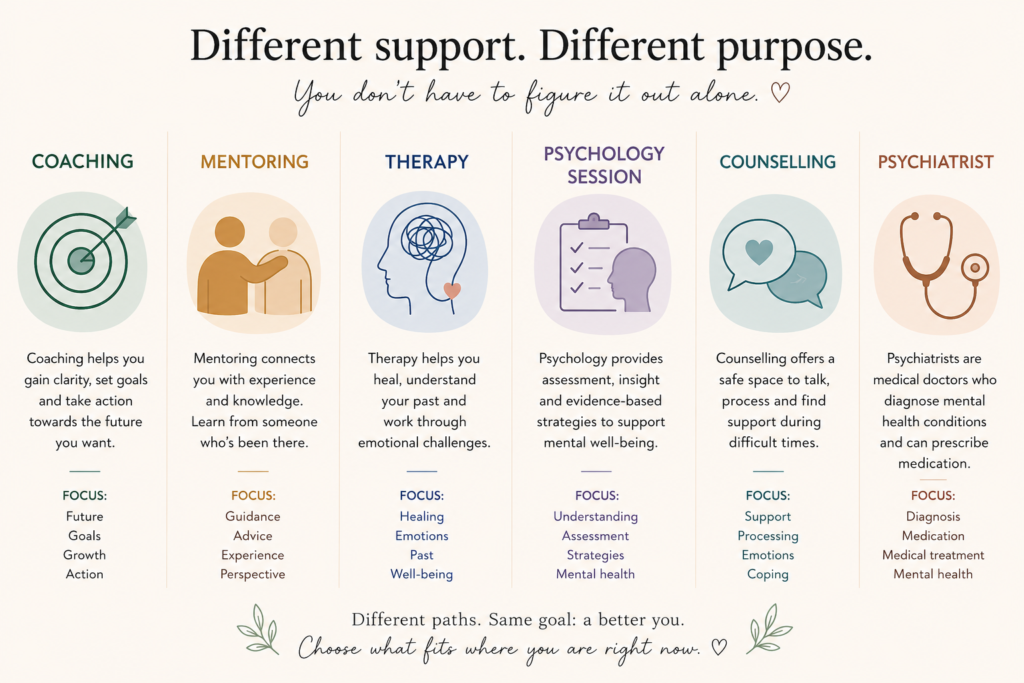
6. Common helping professions, explained
Psychiatrist
A medical doctor specialising in mental health, qualified to diagnose and prescribe medication. The right call for depression, bipolar disorder, psychosis, ADHD, or any anxiety disorder that needs medical management.
Psychologist
Trained in human behaviour and psychological assessment. Depending on country and licence, may diagnose and deliver psychological interventions, but typically can’t prescribe.
Psychotherapist
Works through trauma, anxiety, depression, grief, relationship difficulty, and childhood experience over time, usually with more focus on the past than coaching allows for.
Mental health nurse
A registered nurse specialising in mental health. May support recovery, administer medication, work in hospitals or community services, and provide education and emotional support.
Counsellor
Offers emotional support and space to process life experience such as grief, stress, relationship difficulties, life transitions. Counselling tends to be more supportive and less directive than coaching.
Coach
Works with goals, communication, confidence, leadership, burnout prevention, transitions, and performance. The boundary stays the same wherever coaching shows up: present and future, not diagnosis.
Mentor
Usually informal, often unpaid, and rarely structured into regular sessions the way coaching is. The value is proximity to someone who’s already solved the problem you’re facing.
7. Which kind of support do you need?
There’s no hierarchy here.
Sometimes you need medication. Sometimes you need to heal something old. Sometimes you need practical guidance from someone who’s already walked the path. And sometimes you just need someone to ask you a better question than the one you’ve been asking yourself.
Finding the right support isn’t about finding the “best” profession. It’s about matching the support to the actual challenge in front of you.
8. Growth is rarely linear
At different points in life, we need different things. A therapist may help you heal. A mentor may pass on what they know. A coach may help you see possibilities you hadn’t considered.
And sometimes the bravest thing you can do is admit you don’t have to work it out alone.